


01
RESEARCH & ANALYSIS
This week, several new briefs from the New Blood Awards were published, prompting me to explore additional options beyond the briefs I worked on last week.
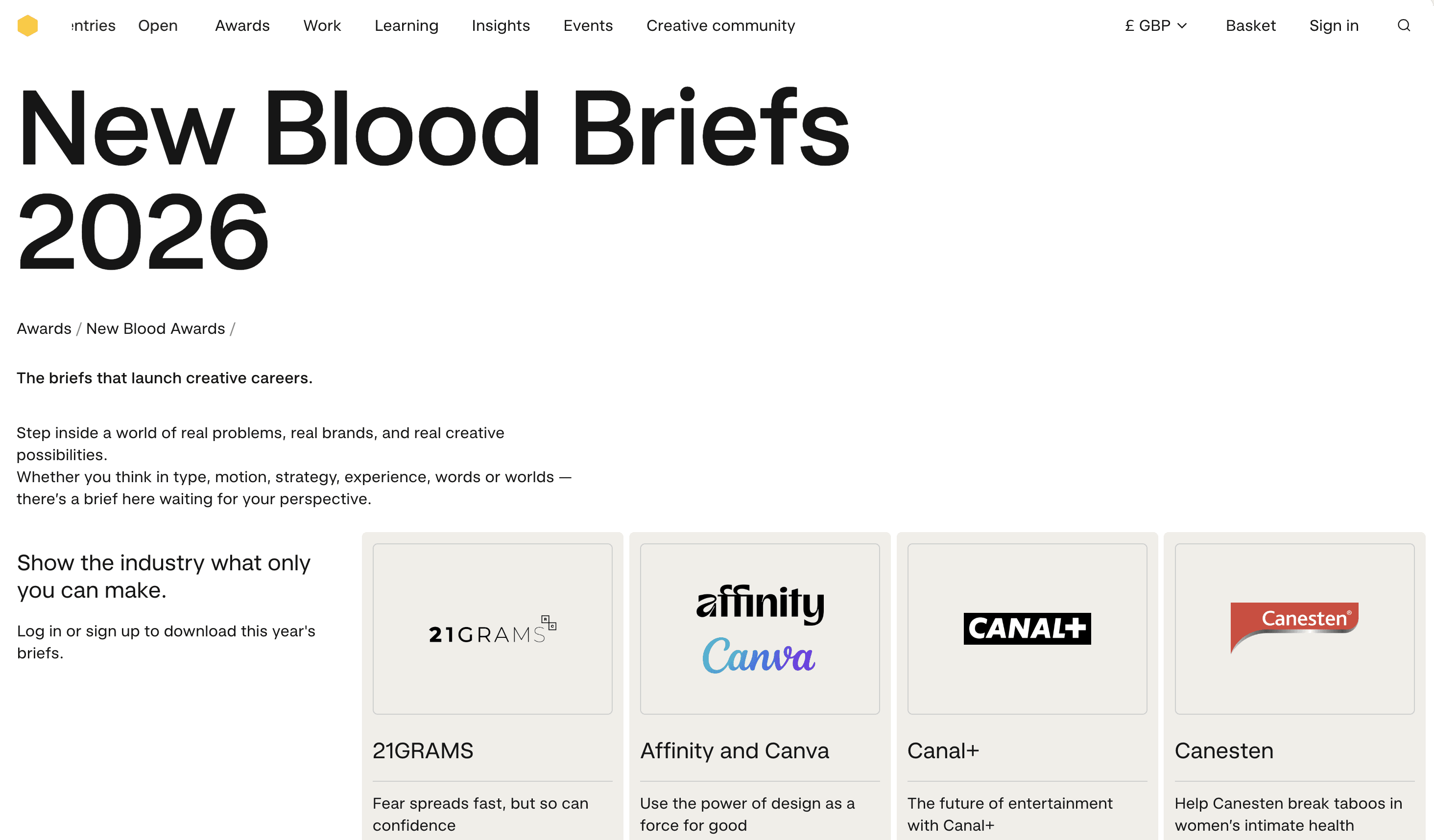
The New Blood briefs are particularly engaging, as they provide more detailed design materials and supporting resources. The New Blood website is also clearer and easier to navigate, making the briefs more accessible compared to Young Ones.
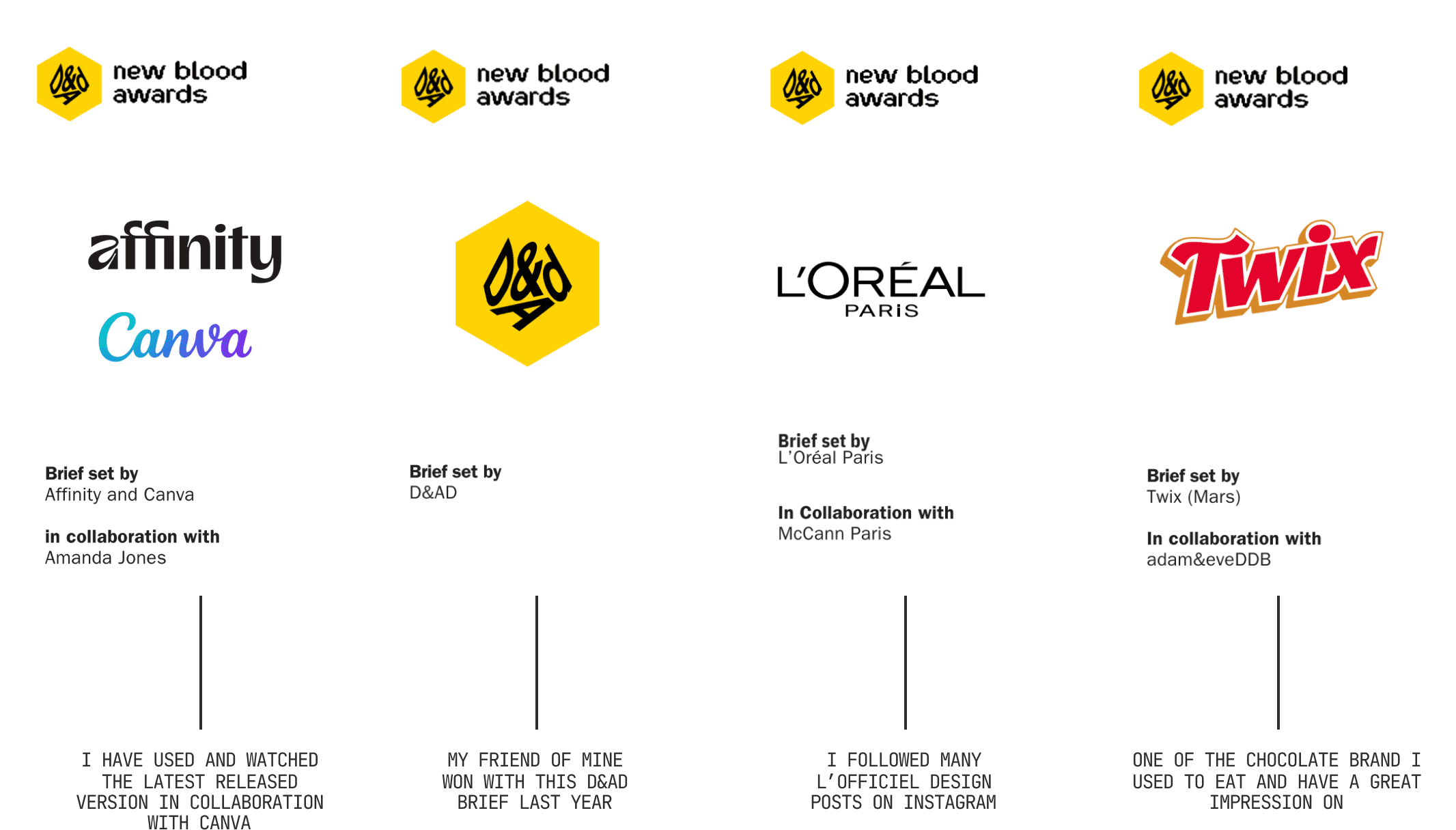
I was particularly drawn to several briefs because they involve industries or brands I am already familiar with. I personally prefer working with known brands, as my existing background knowledge is more valuable than starting research from scratch. Given the limited development time, I prioritised briefs that allow for further development without feeling too unfamiliar or disconnected.
NEW BLOOD DESIGN AWARD - BRIEFS
AFFINITY X CANVA
*BRAND CONTEXT
Affinity and Canva have joined forces to create a comprehensive creative ecosystem designed to empower everyone from students to seasoned professionals.
Affinity focuses on "craft" by providing professional-grade tools for precision and perfecting a vision
Canva focuses on "scale" by making collaboration and visual communication accessible to all.
Together, their shared purpose is to unlock creativity and use design as a catalyst for meaningful change.
✍️ Success requires demonstrating how the "precision" of professional design (Affinity) meets "accessibility and scale" (Canva) to solve a problem.
*CORE CHALLENGE
The brief challenges designers to use the power of design as a "force for good". Pick a problem worth solving, big or small, and use design to make people think, feel or act to make an impact. The issue you tackle is up to you as the designer.
✍️ Freedom to identify problem.
*TARGET AUDIENCE
There is no fixed audience for this brief; instead, the target group depends entirely on the issue chosen, whether it is a global concern or a local community matter. Designers are required to articulate exactly why their idea is relevant to their chosen community.
✍️ The brief emphasizes the need for deep research and first-hand feedback to find unique insights.
*REQUIREMENTS
While the idea is king, the execution must happen within the Affinity and Canva ecosystem.
Mandatory Tools: You must use Affinity and Canva to bring the solution to life.
Access: Affinity is available for free at
affinity.studiostarting October 30th.The "Balance": The brief explicitly warns that this isn't just a software demo. The tools should elevate the idea, not be the focus of the presentation.
✍️ Use Canva for the collaborative/accessible parts of my project and Affinity for the design elements.
*SUBMISSION FORMAT
For the final entry due on 17 March 2026, designers must submit either a 2-minute presentation video or exactly 8 JPEG slides.
✍️ With only 8 slides or 2 minutes to tell the story, I need to spend 50% of the space on the problem and insight and 50% on the visual solution and its impact.
D&AD BRIEF
*DESIGN CONTEXT
Social media has become a "noisy place" saturated with content where authenticity often takes a backseat to trends. However, high-quality content that sparks debate and conversation remains a powerful tool for opening professional doors. Modern audiences often value the comments and the discussion around a post as much as (or more than) the content itself.
✍️ Design context is clear and understandable.
*CORE CHALLENGE
You must create a compelling social media campaign that promotes you. This is not a one-off post; it requires a long-term strategy that embodies your personal brand and true passions. You must demonstrate how your campaign will gain traction, build engagement, and sustain a conversation over time.
✍️ I need to find a "niche" that is uniquely mine.
*TARGET AUDIENCE
The brief identifies two primary groups you need to reach:
Professional Targets: Your "dream" employer, client, or agency. You must tailor your solution to their specific pain points.
The Wider Community: People who share your passions and will help boost the algorithm through active engagement.
✍️ My content must prove my professional worth to a creative director while being entertaining enough for a casual follower to comment on.
*REQUIREMENTS
To successfully answer the brief, your entry must include:
Overarching Idea: How the campaign relates to your practice and your passions
Desired Outcome: A clear statement on whether you want to get hired, build a community, work with brands, or all three.
Content Examples: At least 3 videos (minimum 30 seconds each) OR 5 stills.
Social Strategy: An explanation of your platform choices and how you will drive engagement.
✍️ Authenticity is mandatory. For platforms like TikTok, "face-to-camera" is explicitly recommended to build a human connection.
*SUBMISSION FORMAT
Deadline: 17 March 2026, 5pm GMT.
Main Entry (Essential): One presentation video (max. 2 mins) OR up to 8 JPEG slides.
Supporting Material (Optional):
* If you chose a video main entry, you can add 4 JPEGs.
*If you chose JPEG slides, you can add 1 minute of video.
*Interactive work like websites or apps can also be submitted.
✍️ With only 8 slides or 2 minutes to tell the story, I need to spend 70% of the space on the problem and insight and 30% on the visual implementation.
L'OREAL
*BRAND CONTEXT
In 1971, L'Oréal Paris launched "I'm worth it," the first beauty advertisement written and spoken by a woman, capturing the spirit of female defiance. However, as empowerment messaging became a industry-standard narrative, this iconic tagline has become diluted and often feels performative or hollow in today's climate. To remain relevant in 2026, the brand must return to its radical roots to counter modern misogyny and a world that has become increasingly hostile toward women.
✍️ Return to the original "radical" and "defiant" tone of 1971 to address real-world hostility.
*CORE CHALLENGE
The challenge is to create a campaign that revitalizes the original radical meaning of "I'm worth it" by using beauty as a lever to elevate women's roles and confront a specific current issue they face. The idea should be rooted in striking societal insights or local realities but must maintain a global resonance that speaks to women everywhere.
✍️ The campaign must bridge the gap between a high-level global brand message and local insight that makes the tagline feel necessary again.
*TARGET AUDIENCE
The primary audience consists of women aged 18-65 from all backgrounds globally. While the campaign can focus on the entire demographic, entrants are encouraged to consider targeting specific age ranges or geographies, as seen in previous successful campaigns like "The Non-Issue". Regardless of the specific segment chosen, the solution must treat self-worth as a universal concept that touches all women.
✍️ Identify a specific "pain point" for a sub-demographic (like age or location) to make the message feel more authentic and less like a general broadcast.
*REQUIREMENTS
Participants must develop a big idea and execution that leverages the "I'm worth it" tagline while focusing on four key areas: Authenticity, Opportunity, Security, or Community. The campaign should use the right channels to ensure the story resonates and call attention to a modern reality women face.
✍️ My solution needs to be "action-oriented", mirroring how L'Oréal uses tangible initiatives to back up its tagline.
*SUBMISSION FORMAT
The deadline for submission is 17 March 2026 at 5pm GMT. The main entry must be either a 2-minute presentation video or up to 8 JPEG slides showing the solution.
*Optional supporting materials include interactive work, or a mix of JPEGs and short videos depending on the primary format chosen.
✍️ With only 8 slides or 2 minutes to tell the story, I need to spend 50% of the space on the problem and insight and 50% on the visual implementation.
TWIX BRIEF
*BRAND CONTEXT
For over ten years, Twix relied on the "Left vs. Right" rivalry, but this strategy began to lose resonance in the current cultural climate. In 2025, the brand shifted to a new positioning that celebrates the "joy of having it all," focusing on the literal truth that Twix provides a delicious snack and then gives you the exact same thing again. This move replaces conflict with a celebration of "over-delivery" and "maximalism".
✍️ I need to move away from the old "pick a side", and instead enjoy the fun silliness of getting extra amounts of something nice.
*CORE CHALLENGE
The primary task is to make Twix famous for giving people a "good thing, twice" through an attention-grabbing and culturally relevant brand activation. While the core strategy is "Twix gives you a good thing, twice," the consumer-facing platform is "Two Is More Than One". The goal is to create an innovative idea that goes beyond the product to show that "two-ness" is meaningful and joyful in wider culture.
✍️ The focus isn't on "sharing" one bar with a friend; it's about the selfish, maximalist joy of having "two for you".
*TARGET AUDIENCE
The campaign targets people aged 18 to 35 globally who are familiar with Twix but haven't actively engaged with or purchased the brand recently. This audience consumes 50% of their media in spaces where traditional paid advertising cannot reach, meaning the idea must be inherently talkable and shareable to gain traction.
✍️ To reach under-35s, I should focus on "earned media" opportunities, creating something so entertaining that they want to post about it themselves.
*REQUIREMENTS
Submissions must include a clear insight (social, cultural, or brand-led), the core idea for engagement, and an execution plan showing how it lives in a modern communications ecosystem like social or digital media. Crucially, the idea should avoid "mash-ups" of two different things and should not prove "two is good" by showing that "one is bad" (e.g., a broken tool); instead, it should show that while one is good, two is even better.
✍️ I must maintain a tone of "light-hearted, innocent fun" while avoiding the trap of showing "one" as a negative experience.
*SUBMISSION FORMAT
The deadline is 17 March 2026, 5pm GMT. The essential entry requirement is a 2-minute presentation video OR up to 8 JPEG slides.
*Optional supporting materials include interactive work, additional JPEGs (up to 4 if the main is video), or a short video (up to 1 minute if the main is JPEGs).
✍️ Since Twix wants to be the "ultimate break time snack," my presentation format should reflect the same high energy and entertainment value as the snack itself.
*ADDITIONAL INSIGHTS
Twix specifically looks for "joyful maximalism" and ideas that reinforce the brand's presence during daily breaks, such as mobile gaming, scrolling TikTok, or listening to music. A successful example of this strategy was their retail promotion: "Win A Once In A Lifetime Holiday, Twice".
✍️ I should look for "double" cultural moments.
RESULT & REFLECTION
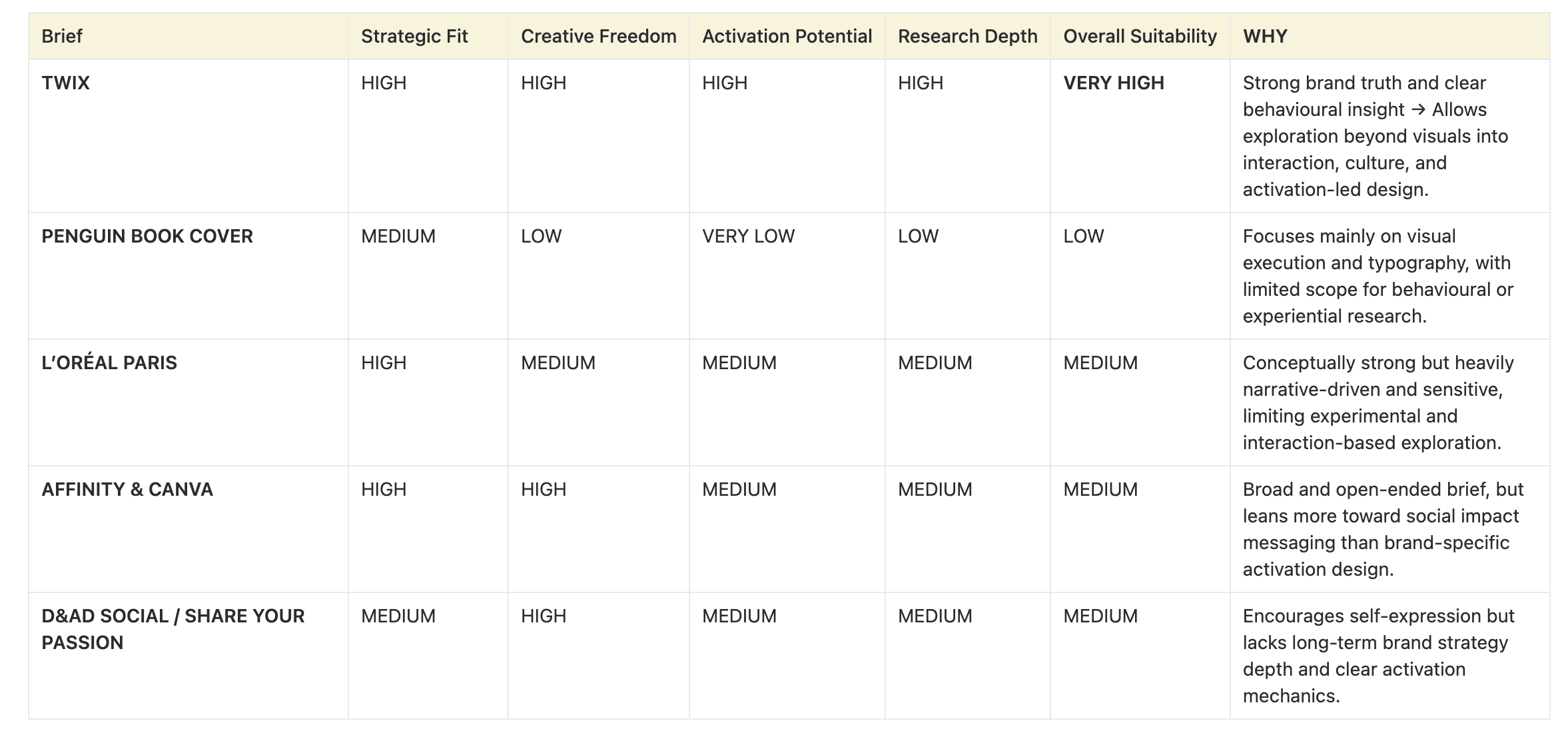
The process of reviewing the briefs was relatively extensive, but overall, most of them were strong and well-constructed. To make the selection process more systematic and transparent, I created a decision matrix to compare and evaluate all the briefs I had reviewed.
👩💻 The final brief selected was Twix. I was particularly drawn to this project because it sits within the F&B sector, and Twix provides a highly detailed and structured set of guidelines, which makes the execution phase more feasible and efficient.
In comparison, the other briefs offered limited space for in-depth graphic design exploration or related specialisms. The Affinity × Canva brief, in particular, would require additional time to relearn and adapt to new tools. Therefore, the final decision was made based on practical considerations, ensuring that the project would be both manageable and enjoyable to develop.
02
PRACTICES & DEVELOPMENT
As the brief emphasises the need to understand tone and voice as well as brand activation, I conducted further research into these key concepts.
Source
/Vai tro Brand Activation trong nganh To chuc su kien (Son Rau)
Keywords
/brand activation
This is a concise video brief explaining brand activation and its role in marketing and event management, supported by clear examples and succinct, engaging analysis.
*Understanding
Marketing Channels
The speaker begins by defining the two traditional pillars of marketing to provide context for brand activation:
ATL (Above The Line): These are mass media channels used to reach a wide audience, such as TV, radio, and print newspapers.
BTL (Below The Line): These channels focus on targeted groups and direct interaction. Examples include events, brand activations, and direct mail campaigns.
Historical Context: In the past, BTL included physical direct mail (catalogs sent to homes), which has now largely shifted to email marketing.
✍️ Marketing channel strategy is also a consideration.
*Definition and Purpose
of Brand Activation
Brand activation is described as a form of targeted advertising designed to drive consumer action through direct interaction.
Goal: To build a relationship between the brand and a specific target audience by allowing them to experience the product or service firsthand.
Objectives: It aims to increase market share and boost brand awareness among specific demographics or regions.
✍️ Brand activation is a customer-first campaign.

*Case Studies of
Traditional Activation
Two professional examples to illustrate how activations functioned in the past:
Nas 400 (General Trade): Activation was carried out in traditional markets (GT - General Trade) to increase market share among women in provincial areas by directing them to local pharmacies.
Coca-Cola "Sound Wave": This large-scale campaign targeted suburban and rural areas to compete with rivals. By offering a concert ticket in exchange for just three bottle caps, Coca-Cola created massive demand, forcing local distributors to stock their products.
✍️ Traditional activations succeed by leveraging physical touchpoints and simple incentives to drive mass demand.


*The Modern Shift
The core difference between past and present activations is the integration of digital technology:
Social Media First: Modern activations often start online to build hype and capture attention before moving to an offline event.
The Blackpink Example: Using the Blackpink concert in Vietnam as a case study, he notes how the organizers used social media and websites for announcements and ticket sales before the actual physical event at My Dinh Stadium.
Blurred Lines: The distinction between ATL and BTL is disappearing, leading to the concept of TTL (Through The Line), where digital and physical experiences are seamlessly integrated.
✍️ Modern activations are increasingly digital-first, blending online hype with offline experiences through integrated touchpoints.
*The Value of
"Classic" Marketing
Standing Out: Because most brands are currently focused on digital and social media, returning to "classic" methods like high-quality print magazines or books can create a strong, specialized connection with the audience.
Personal Connection: Classic media allows a deeper "entry into the mind" of the author or brand, offering a different value proposition than the fast-paced nature of the internet.
✍️ “Classic” marketing regains value by offering depth, focus, and differentiation in a digital-saturated landscape.
RESULT & REFLECTION
This week, I gained a basic understanding of brand activation and its definition, but I am still unclear about how it can be presented or translated into a concrete execution.