

01
RESEARCH & ANALYSIS
For this semester, instead of allowing students to propose their own briefs for side projects, the faculty team changed the format by providing competition briefs. Students who wished to work on a self-initiated brief were required to discuss and justify it with the faculty in person.
👩💻 Because the briefing process took longer than expected and new briefs were released gradually. I decided to wait until this stage so that the brief options would be more complete before making a decision.
Overall, the briefs could be grouped into three main levels: easy, mid, and challenging.
From my perspective, the YoungOne brief was the most demanding. Although it involved a real client, the focus leaned more towards marketing than design.
In contrast, the Penguin brief felt more accessible and open-ended, as it functioned as a free design system for book covers, allowing greater flexibility in visual exploration.
YOUNGONE BRIEFS
👩💻 The first brief I identified focused on designing for Google Gemini. As I am considering a future direction in product design, this brief felt closely aligned with my long-term career interests.
My task was to break down the key components of the brief and conduct light initial research into the challenges faced by Google Gemini. Based on the insights gathered, I evaluated whether I had sufficient understanding and capability to respond to the brief in a meaningful way.
GOOGLE GEMINI - CREATIVE USE OF AI
*CORE MISSION
Pick a real education problem and fix it for one student, teacher, or group using Gemini. Show how this small win scales up to help tons more people, making learning more accessible, personal, and fun.
✍️ Prove your fix for "one" can go big for "many".
*PRODUCT FOCUS
The solution must be built around the specific capabilities of Gemini, which is a multimodal model.
Multimodality: Gemini can understand and reason across text, code, images, audio, and video.
Role in Education: It should act as a personal tutor, research assistant, or creative partner.
Human-Centric: The focus is on nurturing curiosity and allowing students to learn "on their terms" rather than just finding the "right" answers.
✍️ The entry must center on Gemini’s ability to combine different types of info (like audio + video + code).
*STRATEGY
& CONSTRAINTS
Successful entries must show genuine educational transformation within a classroom or learning environment. Google explicitly warns against "generic AI features" or ideas that simply use AI to find the "right answer". Instead, the solution should focus on making learning more personalized and effective while maintaining a clear path to scalability.
✍️ Avoid "homework helper" ideas; focus on tools that inspire exploration and long-term learning.
*FINAL
DELIVERABLES
Bring Gemini to life with cool demos and walkthroughs. Best categories: Creative AI Use, Film/Video, Interactive, Social Media, OOH. Use visuals to tell the story from problem to big impact.
✍️ High-quality demo in action.
PENGUIN BOOK COVER DESIGN AWARD
PENGUIN BOOK COVER DESIGN
*OVERVIEW
The goal is to reimagine a classic work of Classic Fantasy for a modern audience. Penguin is looking for a cover that stands out on a crowded bookshelf while staying true to the core essence of the story.
✍️ Bridging the gap between the book's historical heritage and contemporary design trends.
*SELECTED TITLES
(CHOOSE ONE)
"Night Watch" by Terry Pratchett: A complex, satirical, and dark-yet-funny journey into the Discworld's history.
"A Wrinkle in Time" by Madeleine L’Engle: A seminal work of science fantasy involving cosmic travel, darkness, and the power of love.
✍️ Choosing one title forces a clear conceptual focus and a deeper visual interpretation of a single narrative world.
*DELIVERABLES
Format: A single PDF including the Front Cover, Spine, and Back Cover. You must download and use the official Penguin templates.
Do not change the dimensions of the spine or the flaps.
Do not move the Penguin Logo from its designated spot.
Text (Copy): You must use the specific "Cover Copy" provided in the download pack (Blurb, Reviews, and Author Bio).
✍️ Strict templates and fixed layouts shift the focus from structure to concept and visual clarity..
*TARGET AUDIENCE
Modern Readers: People who may not have discovered these classics yet.
Collectors: Fans of the authors who want a "fresh" or "definitive" edition for their shelves.
Retail Environment: The design must work for both physical bookstores (Waterstones, independent shops) and digital platforms (Amazon, Instagram).
✍️ The outcome prioritises precision and consistency across a complete book cover system.
*EVALUATION
CRITERIAS
The judges (Art Directors from Penguin Random House) will grade based on:
Concept: How clever and relevant is your visual idea?
Execution: Technical skill in illustration, photography, or graphic composition.
Typography: Choice of fonts and layout of text.
Impact: Does the cover evoke an immediate emotional response?
✍️ Standards are clear and imaginable.
*CONSTRAINTS
No Generative AI: Use of AI-generated imagery (Midjourney, DALL-E, etc.) is strictly prohibited and will result in disqualification.
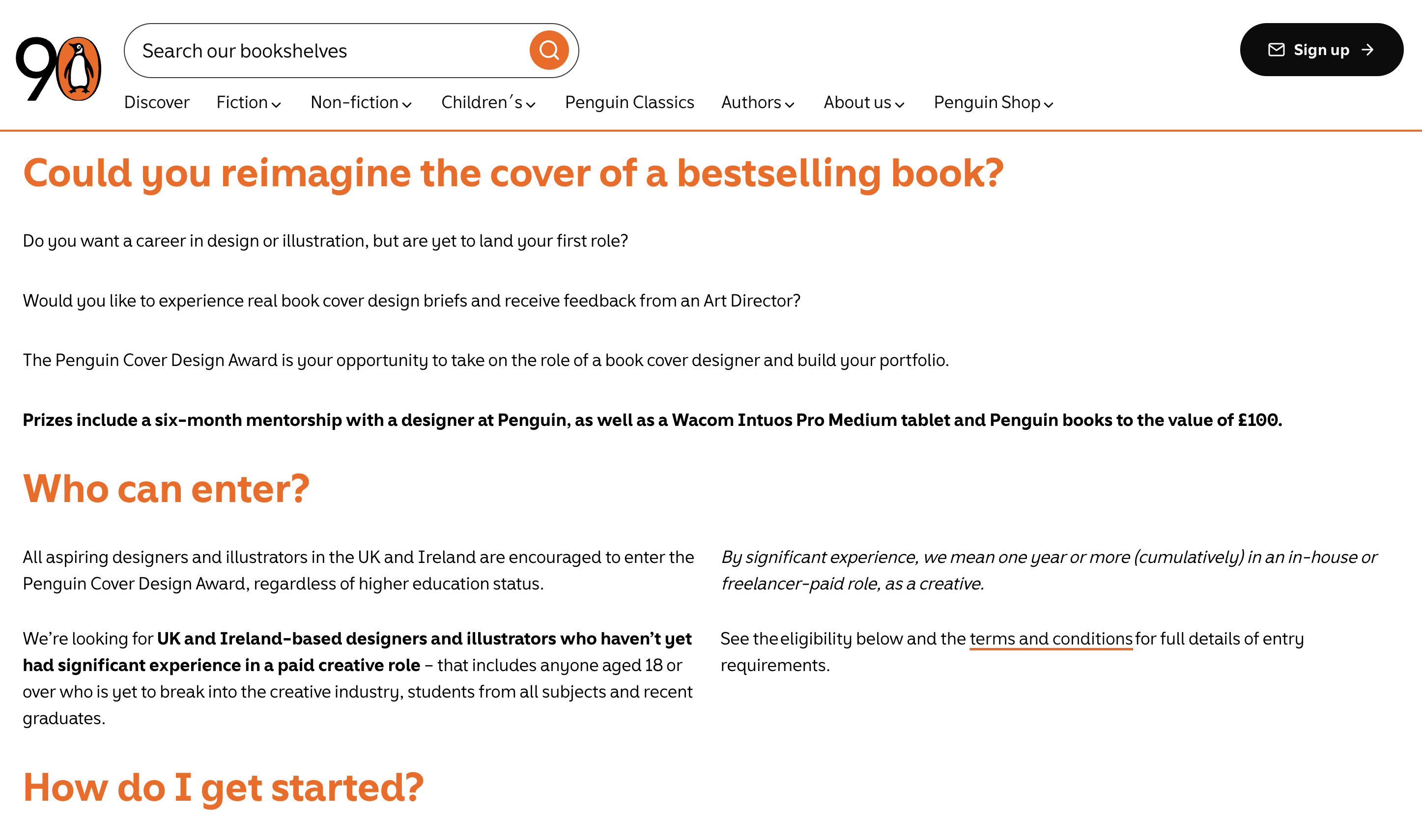
Eligibility: You must be a resident of the UK or Ireland and be 18+ years old.
Professional Status: This is for "unestablished" designers (those who haven't worked extensively as paid book cover designers).
✍️ The constraints intentionally limit tools and status to foreground raw design thinking and authorship.
RESULT & REFLECTION
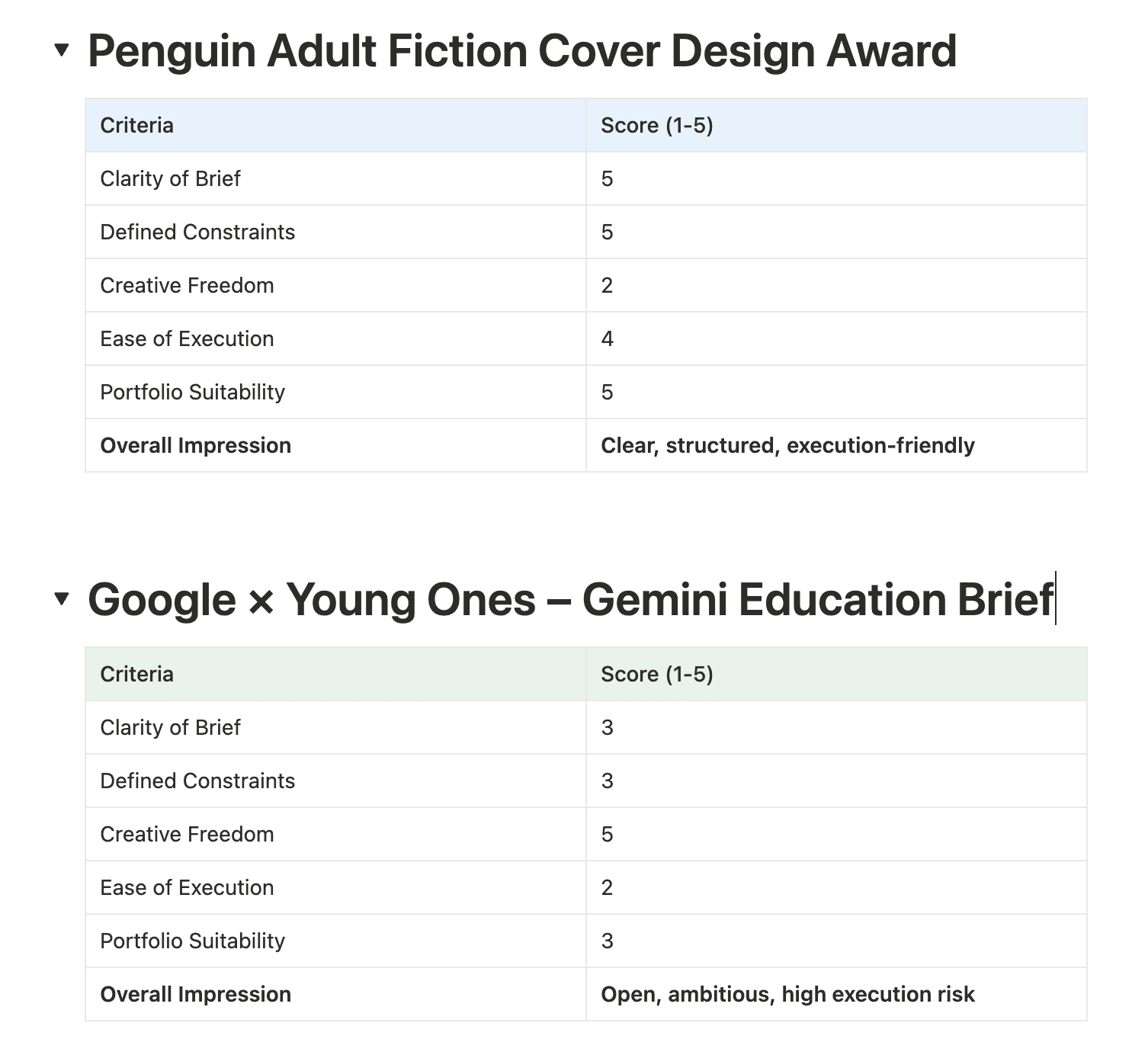
Overall, neither of the two briefs feels fully aligned with my interests so far. However, to investigate further, I plan to evaluate them based on clarity, as the clearer brief is likely to be more practical and easier to develop.
Overall, the Penguin brief offers higher clarity and control, while the Google brief prioritises openness but demands greater self-definition and carries higher execution risk.
02
PRACTICES & DEVELOPMENT
To better understand the design approach of both briefs, I reviewed several examples to visualise their expectations.
👩💻 To begin, I gathered visual references for my website to identify a visual direction that felt natural to me.
The focus was on testing layout, grid systems, and text hierarchy to ensure the navigation remains clear and easy to follow.
Source
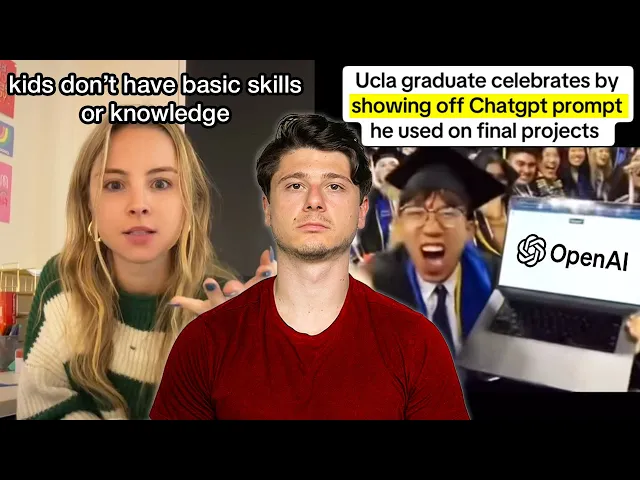
/How AI is Ruining Education For Everyone (Cole Hastings)
Keywords
/AI in education
This is a deep-dive exploration of the "AI education crisis" in 2025. It examines the profound disruption caused by Large Language Models (LLMs) in classrooms from both the student and teacher perspectives.
*Widespread AI Integration
in Education
Data shows a massive adoption of AI, with 86% of university students and nearly half of high school students using AI tools like ChatGPT. Interestingly, 84% of teachers also use AI for lesson planning and material generation
✍️ AI is now a widely used tool in education for both teachers and students (validated).
*The "Steroid" Analogy
and Loss of Critical Thinking
The video compares AI to steroids. If students outsource the "struggle" of thinking, reflecting, and summarizing to AI, they fail to develop the "mental muscle" needed for problem-solving and critical reasoning.
✍️ AI can become a barrier to the natural process of learning.
*The Crisis of "Grit" and
Intellectual Stamina
A major concern is that AI discourages persistence. Students are becoming less inclined to wrestle with difficult concepts, often giving up within minutes to seek an AI-generated answer instead of using their own brainpower.
✍️ AI creates a sense of convenience that makes learning increasingly passive.
*AI Hallucinations and
Misinformation
AI frequently "hallucinates" or creates fake citations and facts. Students often lack the background knowledge or skepticism to fact-check these outputs, leading to the spread of misinformation and a potential decline in information literacy.
✍️ AI blurs the distinction between reliable information and fabricated content.
*Ambiguous Boundaries
in Usage
There is a confusing line between "acceptable" use (like idea generation) and "unacceptable" use (writing the actual text). This inconsistency is worsened by universities providing AI tools (like Microsoft Copilot) while some professors ban them.
✍️ Conflicting views on teachers’ AI usage create confusion for students.
*The Risk of "Slop"
and Loss of Voice
AI-generated writing tends to sound generic and "robotic." When both students and teachers rely on it for essays or exemplars, it eradicates the unique human voice and personal style that writing is supposed to develop.
✍️ AI limits the development of natural, individual writing voices.
*Potential for
Positive Evolution
Despite the risks, the video suggests AI could be beneficial if used as a "second brain" (like a calculator or thesaurus) to enhance understanding rather than replace thinking entirely. Some experimental schools even use AI to condense core subjects, freeing up time for real-world life skills.
✍️ AI can still function as a useful support tool, as long as it is not overused.
Source
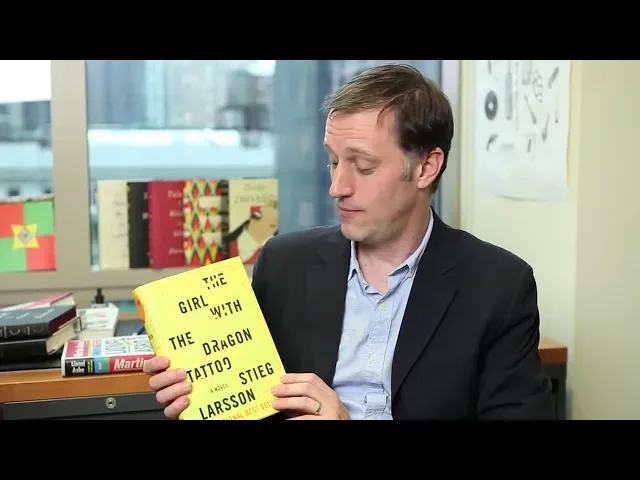
/Inside Random House: "The Art of Cover Design" (Penguin Random House)
Keywords
/penguin book cover design
This video explores the creative process behind making a book's visual identity. The process is deeply collaborative and iterative, requiring designers to immerse themselves in the manuscript, experiment with hundreds of sketches, and find inspiration in everyday life to create an iconic image that lives on with the text.
*Evocation Over
Illustration
A cover shouldn't just summarize the plot; it should capture the "mood" and provoke curiosity to make someone pick up the book.
✍️ Focus on creating an emotional hook.
*Deep Contextual
Immersion
Designers must "live" in the text, consulting with authors and editors to ensure the visual identity aligns with the book’s soul.
✍️ Research before you execute. You cannot build a meaningful solution without deeply understanding the "why" behind the project.
*Preserving the Reader's
Imagination
Showing too much (like a character’s face) can limit the reader's experience. Using abstract or partial imagery leaves room for personal interpretation.
✍️ Don't over-explain; let people bring their own imagination to your work to make it more personal to them.
*The Iterative Grind
Great design is the result of hundreds of failed attempts. The "perfect" cover is often found only after exploring every wrong direction.
✍️ Trust the process.
*Accidental Inspiration
Breakthroughs often come from non-literary sources, like museum visits or experimenting with a photocopier on a whim.
✍️ Look for answers in unexpected places and keep your "creative antenna" up at all times.
RESULT & REFLECTION
After reviewing the challenge directions of both briefs, I gained a clearer overall understanding of what each brief aims to achieve and whether it is something I can develop.
👩💻 With Google Gemini, this brief feels particularly challenging, as AI remains a highly debated topic within art and design.
If I continue with this direction, creative exploration may be limited, and there is a high risk of ethical concerns if the concept is not clearly positioned. Without a strong direction, the work could easily be misread as AI art or a purely technical AI implementation rather than a design-led outcome.
👩💻 With the Penguin Book Cover brief, this direction feels more approachable and engaging compared to the Google brief.
One key insight is that book cover design is not about illustrating something “beautiful,” but about understanding the book, the author’s intent, and translating narrative meaning into visual storytelling. This brief places strong emphasis on metaphor and visual communication.